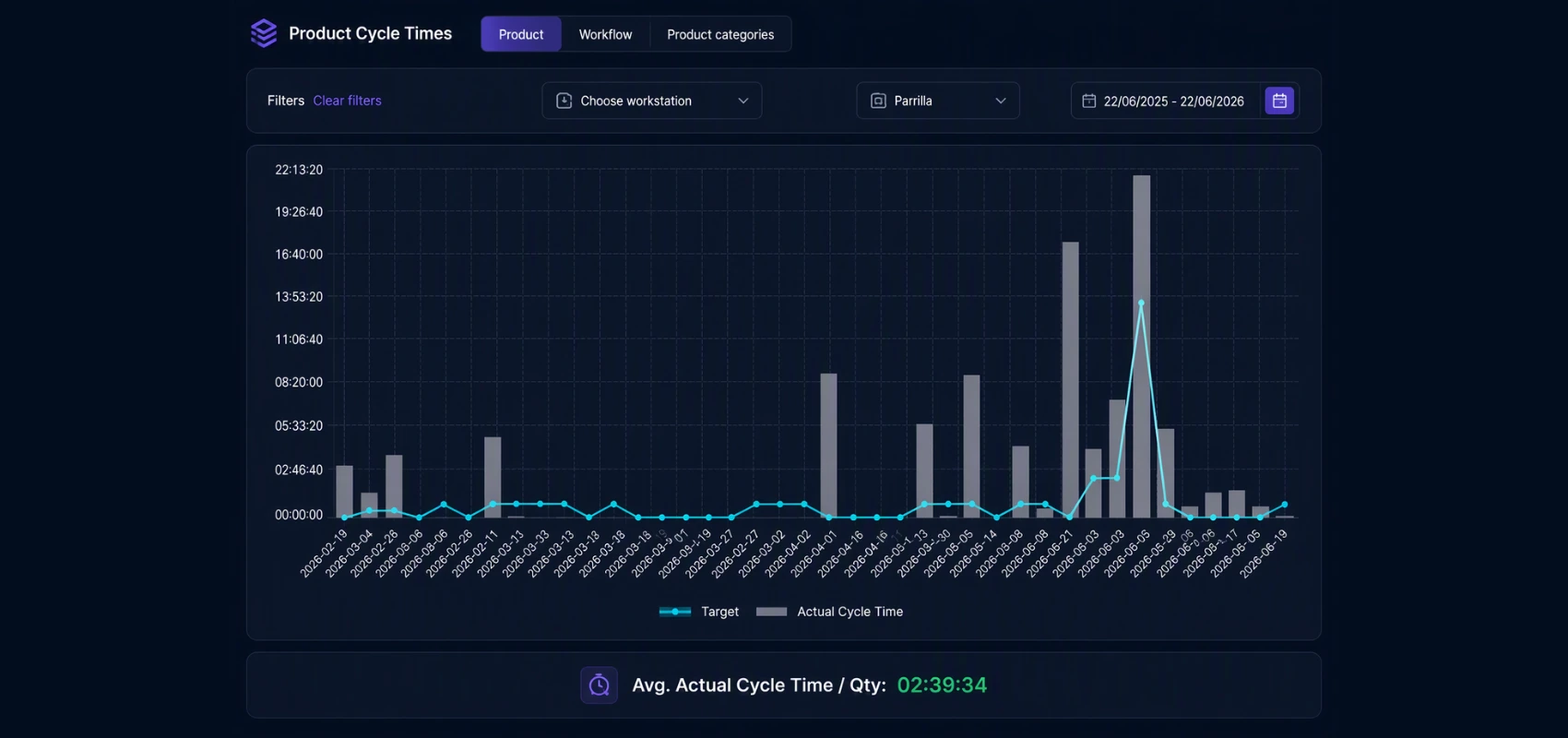
Epifor MES measures real production times from your operator's actions. Then uses machine learning to "Learn" your production and deside's accurate cycle times, which are used in the whole platform.
Epifor's Time Measurement & Machine Learning shows your real product cycle times and actual costs. It captures production times in all possible scenarios in a labor intensive environment and uses them in the reporting, forecasting and target times to operators. It is constantly train on your own production, so the numbers reflect reality and improve as you run.
Advanced Time measurement
Time, captured how your floor really works.
All possible scenarios of a labor intensive environment are covered. Operators might run several jobs at once, work on a common workcenter or work as a team, Epifor captures the productivity of each one separately and accuratetly calculates the cycle times of the products
Parallel jobs
Several jobs at once, time split accurately based on number of active jobs, quantity completion and target time of the jobs
Multi-login
Several operators on the same job or several jobs at once. Epifor captures the real time of the products and the productivity of the operators.
Different terminal same work center
Operators can loggin each one on its own terminal and declare quantity or the same manufacturing orders at the same work centers.
Machine Learning for Product Cycle Time Calculation
Actual product times.
Capture the real times of your products and your product categories constantly. Stop relying on times that you measured once in a manual way. Let Epifor show you the your actual times that will affect the way you plan, and the perspective of your costs.
Trained on your resources
Epifor learns from a combination of your work centers and operators
Accurate cycle times for every entity
Machine Learning calculates times for your products, categories and workflows.
Adjusts as you evolve
Over time changes of operators or machines affect your cycle times
Target Times even if its the 1st time that you produce a product
Smart algorythm grounded in reality.
Target times can be the factory's nominal times or the times of the machine learning mechanism. The smart algorythm decides which is the best time to choose with priority on your nominal times, so even if its the 1st time that you produce somethings it will have a time for your capacity planning and forecasting.
Nominal Times
You can imput the nominal times of the factory
Actual vs nominal
See in a glimps the deviation from nominal to actual even by work center
Better planning and costing
Machine learning feed planning and scheduling, and can be send back to ERP for costing purposes
Frequently asked questions
Q.01What is machine learning for cycle time calculation?
It is using your real production data to calculate accurate cycle times automatically. Instead of fixed estimates, Epifor learns from the times it measures on each operation and station and updates the cycle time as more jobs run. The result is a number grounded in how your floor actually performs.
Q.02How is this different from a time study or a consultant with a stopwatch?
A time study captures a moment; Epifor learns continuously. Rather than one person timing a station once, the system uses every real run to keep the cycle time current, so it stays accurate as products, people and conditions change.
Q.03What does "advanced time measurement" handle that basic tracking doesn't?
It handles the messy reality of a shop floor: one operator running several jobs in parallel, and several operators sharing one job or station. Epifor splits and credits the time accurately across all of it, so your data holds up even when work overlaps.
Q.04How are target times set?
Target times are based on what your floor really achieves, drawn from the learned data, and you can adjust them. You then compare actual against target by operation and station to plan, quote and improve.
Q.05How much data does it need before the numbers are useful?
Epifor is useful early and gets sharper over time. Even a handful of runs gives a working cycle time, and accuracy improves as more jobs accumulate. You are never waiting on a long setup to get value.
Q.06Does it work for manual assembly, not just machines?
Yes. Epifor captures manual and machine cycle time and handles parallel manual jobs. So, it fits labor-intensive and custom manufacturing as well as machine shops.
Q.07Does it connect to planning and costing?
Yes. Accurate cycle times and targets feed scheduling and quoting directly, inside the same shop floor management system, so the times you measure become the times you plan and price on.
Q.08How does this relate to takt time?
Takt time is the pace you need to hit to meet customer demand; cycle time is how long the work actually takes. Epifor measures your real cycle times, so you can compare them against takt, spot any station running above it, and balance the line accordingly.
Free online presentation
See your floor working together
Book a short presentation. We'll show job-based chat, real-time notifications, and role-based access inside one shop floor management system.